AI-Powered Personalization at Scale: Turning Investment into Impact
AI personalization is now a strategic priority for growth focused brands. But despite rising investment, many organizations still struggle to achieve measurable ROI. The gap is not in ambition it is in execution.
LINO Consulting & Research GmbH
6/10/20263 min read


As personalization strategies mature, the focus is shifting from isolated AI experiments to enterprise-wide systems that deliver real-time, data-driven customer engagement at scale. The next wave of competitive advantage will come from combining predictive analytics, generative AI, and automated decision-making in a way that is both operationally integrated and commercially effective.
Why personalization investment often underperforms
Many companies have increased spending on AI, digital marketing, and personalized content—but results often remain inconsistent. A common reason is that personalization is still being treated as a set of disconnected pilots rather than a scalable business capability.
In practice, this means brands may test AI-generated content, recommendation engines, or campaign optimization tools without addressing the deeper infrastructure needed to support them. Customer data remains fragmented, workflows stay manual, and insights fail to move across channels in real time.
Real-time personalization is becoming the new growth engine
The commercial opportunity in AI-powered personalization is significant. The biggest gains are emerging where businesses can adapt digital experiences in real time based on customer behavior, intent signals, and context.
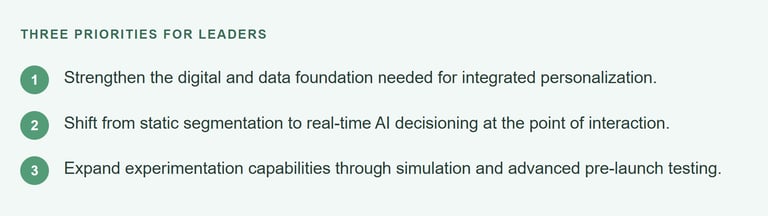
This marks an important shift in go-to-market strategy. Traditional segmentation and scheduled campaign logic are no longer enough in a digital environment where customer expectations change by the second. Leading organizations are moving toward real-time personalization where websites, offers, messages, and product recommendations adjust dynamically at the point of interaction.
This approach improves customer engagement, increases relevance, and creates faster revenue impact. It also helps organizations build stronger feedback loops, allowing AI models to learn continuously from behavior and improve decision quality over time. In this sense, personalization is no longer just a marketing tactic it is becoming a core digital growth engine.
Scale requires unified automation, not isolated content pilots
One of the biggest barriers to successful personalization at scale is organizational fragmentation. Many businesses invest heavily in front-end experiences while leaving backend systems, data architecture, and workflow design largely unchanged.
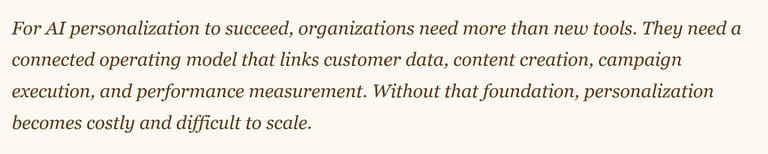
That limits impact. Scalable personalization depends on unified automation across the full customer journey. Data must be accessible and reliable. Decision engines must operate across touchpoints. Content generation must be tied to business rules and commercial objectives. And teams across marketing, product, analytics, and technology must work from the same playbook.
Companies that industrialize personalization through shared platforms and integrated workflows are more likely to turn experimentation into repeatable value. Those that continue to rely on siloed campaigns and one-off pilots risk spending more while learning less.
Synthetic customer testing could redefine personalization strategy
Another emerging development is the use of AI-generated, data-backed customer simulations to test marketing strategies before launch. Instead of relying only on live campaigns to understand how target audiences may respond, organizations can simulate reactions from representative buyer profiles assessing which messages, journeys, or offers are most likely to perform.
This can reduce wasted spend, improve targeting accuracy, and shorten testing cycles. As personalization becomes more complex with more content variants and decision paths pre-launch simulation can help organizations focus resources on the most promising opportunities. It also allows teams to identify weak assumptions earlier, reducing the cost of trial and error in market.
For brands seeking better campaign performance and smarter use of AI, this capability may become an important competitive differentiator.
Strategic takeaways for leaders
AI personalization is moving into a more operational and results-driven phase. The question is no longer whether personalized customer experiences matter. It is whether organizations can build the systems required to deliver them effectively at scale.
Companies that get these elements right will be better positioned to unlock higher conversion, stronger customer loyalty, and more efficient growth. In a crowded market, scalable personalization may become one of the clearest sources of competitive advantage.
References
McKinsey & Company. (2026). The AI paradox in Europe's consumer. industries: More spending, elusive impact.
Boston Consulting Group. (2024). Capturing the $2 trillion .personalization opportunity with AI.
Bain & Company. (2026). Synthetic customers earn their. stripes.
We turn market complexity into executive decisions
Get in Touch
© 2026. All rights reserved.