Beyond Shortcuts: Why “Anti-Hacks” Are Reshaping Performance Marketing
Explore how anti-hacks in performance marketing are replacing short-term tactics with sustainable growth, stronger brand trust, and data-driven systems.
LINO Consulting & Research GmbH
5/20/20263 min read


Performance marketing is entering a reset. The old promise of "hacks" — quick wins, channel loopholes, and vanity-metric spikes — is giving way to a more disciplined model built on trust, systems, and measurable durability. Across the source material, a common pattern emerges: strong-performing organizations are not abandoning experimentation, but they are moving beyond hack-first thinking toward structured growth engines that compound over time.
Why the hack mindset is losing effectiveness
The anti-marketing perspective reflects a broader market shift: audiences are increasingly skeptical, attention is scarce, and louder promotion often creates diminishing returns rather than stronger brand affinity. Strategic restraint, honesty, and pattern interruption can often outperform constant promotional pressure in oversaturated environments.
The same pattern appears from a growth perspective. Growth hacking is no longer defined by disconnected tricks or vanity metrics. It is evolving into a more rigorous, data-backed system designed to turn product value into repeatable growth. The implication is clear: performance marketing is moving from opportunistic tactics to engineered outcomes.
Durable performance now depends on systems, not stunts
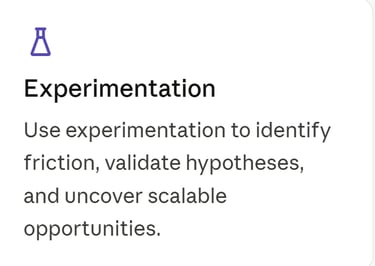
One of the clearest themes across the materials is the rise of systems thinking. Sustainable growth increasingly depends on repeatable processes across acquisition, activation, retention, and expansion rather than isolated campaign wins. Structured experimentation with clear hypotheses, measurable benchmarks, and documented learning stands in direct contrast to guesswork-led optimization.
This matters because systematized growth allows lessons to compound. Hack-led growth, by contrast, often fades as soon as the tactic saturates or the platform changes.
Brand and performance are converging again
Another major shift is the move away from pure short-term activation toward long-term trust building, authenticity, and clearer value perception. At the same time, marketing is becoming more full-funnel, combining equity-building activity with direct response objectives.
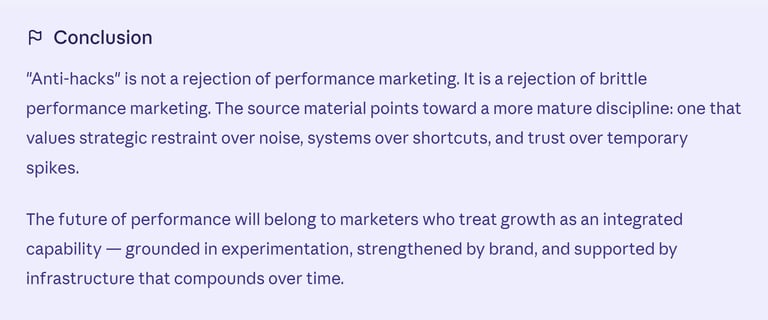
That has major implications for performance marketing. Anti-hacks are not anti-performance; they are anti-fragmentation. The emerging model is not brand versus performance, but brand as a performance multiplier. In uncertain markets, trust and relevance improve conversion efficiency over time.
AI is accelerating the shift away from hacks
AI is making the anti-hack mindset even more relevant. Many companies are using AI for content generation, but far fewer are building the structured data, workflows, and machine-readable infrastructure needed for discoverability in AI-driven environments.
For performance marketers, this changes the rules. Older hacks often relied on exploiting temporary platform mechanics. In AI-mediated discovery, visibility increasingly depends on consistency, infrastructure, and structured information rather than content volume alone.
What leaders should do next
The practical takeaway is not to stop experimenting, but to redefine experimentation. Anti-hacks in performance marketing means fewer random bets, tighter strategic focus, and stronger alignment between brand, growth, data, and infrastructure.
A stronger operating model emerges from the source material:
References
Ainoa Agency. (n.d.). What is anti-marketing? Guide. https://www.ainoa.agency/blog/what-is-anti-marketing-guide
Breakthrough3x. (n.d.). 5 critical marketing challenges. https://breakthrough3x.com/uncategorized/5-critical-marketing-challenges/
Data Mania. (n.d.). Growth marketing consultants to watch. https://www.data-mania.com/blog/growth-marketing-consultants-to-watch/
GrackerAI. (n.d.). Understanding growth hacking in digital marketing. https://gracker.ai/blog/understanding-growth-hacking-in-digital-marketing
McKinsey & Company. (n.d.). Past forward: The modern rethinking of marketing’s core. https://www.mckinsey.com/capabilities/growth-marketing-and-sales/our-insights/past-forward-the-modern-rethinking-of-marketings-core
Pressonify. (n.d.). McKinsey’s State of AI 2025, the marketing visibility gap and how to close it. Medium. https://medium.com/@Pressonify/mckinseys-state-of-ai-2025-the-marketing-visibility-gap-and-how-to-close-it-a7ddb7fd38a8





We turn market complexity into executive decisions
Get in Touch
© 2026. All rights reserved.