Transforming Analytics into Revenue: Bridging GA4 with Behavioral Data for Business Success
Discover how GA4 insights can drive revenue by turning behavioral data into better forecasting, stronger conversion strategy, smarter audience targeting, and more effective sales and marketing decisions.
LINO Consulting & Research GmbH
5/13/20263 min read


The core insight: GA4 does not create revenue on its own. What it does create is a more usable stream of behavioral data: events, journeys, drop-offs, return patterns, and signals that can feed forecasting, experimentation, and better commercial decisions. The bigger lesson is that value comes when firms connect analytics to operating choices, not when they simply collect more data. Organizations now have large volumes of raw data and more sophisticated tools, but many still struggle to turn those inputs into measurable business value.
Revenue starts where reporting ends
The most useful GA4 insight is rarely a top-line traffic number. It is the signal that changes a decision: which journeys correlate with conversion, which audiences are worth re-engaging, where friction appears in the funnel, and which behaviors predict higher-value outcomes. Analytics is most powerful when decisions move from instinct to evidence, experiments, and more accurate forecasts. For revenue teams, that means using GA4 less as a reporting dashboard and more as an operating system for prioritization.
Predictive value comes from connected behavior data
A core advantage of GA4-style event data is that it captures what users actually do, not just where they came from. That matters because prediction improves when organizations can connect behavior patterns to downstream outcomes. Research on AI adoption shows that firms report significant changes in key performance indicators after integrating predictive models, with statistically significant links to measurable business outcomes. The implication is practical: predictive models can support performance gains, but value realization depends on how well adoption is embedded in the business.
The constraint is not data volume—it is execution
One of the clearest findings from our research and market analysis is that the barriers to effective analytics are often strategic and organizational, not technical. From interviews with leading organizations, the top challenges cited include:
45% cite designing an appropriate organizational structure to support data and analytics
42% cite ensuring senior management involvement and alignment
36% cite designing effective data architecture and technology infrastructure
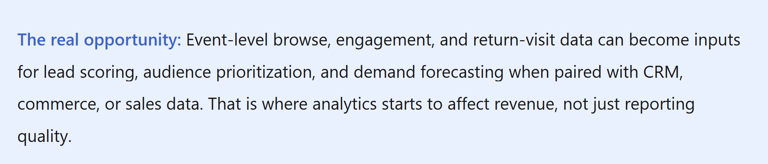
In other words, organizations do not usually fall short because they lack dashboards. They fall short because ownership, workflows, and decision rights are unclear. Many organizations can instrument events, build explorations, and export data. Fewer can translate those outputs into media allocation changes, pricing moves, sales prioritization, or lifecycle interventions. Revenue impact depends on that translation layer.
Trust determines whether insights get used
Adoption of analytics insights stalls when users do not trust how models work, why recommendations are being made, or who remains accountable for decisions. Success requires clear communication, transparent usage guidelines, clear accountability, and safeguards that build confidence in the analytics function.
That matters for GA4-led revenue work because predictive audiences, propensity models, and attribution outputs only create value when commercial teams actually act on them. If marketing, sales, and leadership do not trust the logic behind the signal, the model may be technically sound but commercially irrelevant.
What actually drives revenue from GA4
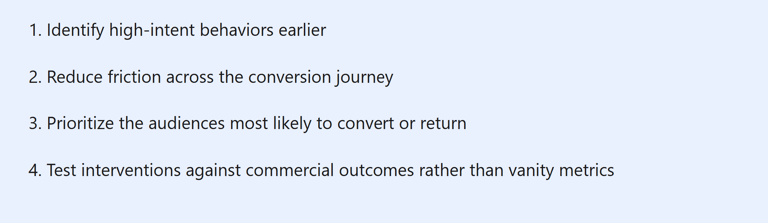
The most revenue-relevant GA4 insights are the ones that help teams do four things better:
The key insight is that analytics leaders create advantage when they embed insights into day-to-day processes and decision making. Performance gains show up in business results only when adoption moves beyond experimentation and becomes core to how the organization operates.
The bottom line
GA4 is not a tool that creates revenue on its own. It is a foundation for more usable behavioral data events, journeys, drop-offs, return patterns, and signals that feed forecasting, experimentation, and better commercial decisions. Revenue comes from connecting that data to operating choices. Organizations that win are those that move past reporting and embed analytics into the workflows, decision rights, and accountability structures that actually move commercial outcomes.
References
McKinsey & Company. (2025). The state of AI: How organizations are rewiring to capture value. McKinsey Global Survey. on AI.
PwC. (2025). AI jobs barometer 2025: The economic impact of AI on workforces and productivity. PricewaterhouseCoo-pers.
World Economic Forum. (2025). Future of jobs report 2025. World Economic. Forum.
Google, Temasek, & Bain & Company. (2025). e-Conomy SEA 2025: Profits on the rise, -harnessing SEA’s advantage.
Accenture. (2025). Reinventing enterprise operations- with generative AI. Accenture Research.
Deloitte. (2025). State of generative AI in the -,enterprise. Deloitte Insights.
We turn market complexity into executive decisions
Get in Touch
© 2026. All rights reserved.