
Business Analytics Market Outlook: Growth, AI Disruption, and the Future of Data-Driven Decisions
From the US to Asia-Pacific, business analytics is evolving fast powered by AI, cloud, and real-time data to drive smarter decisions globally.
LINO Consulting & Research GmbH
4/21/20264 min read
Market Overview & Growth
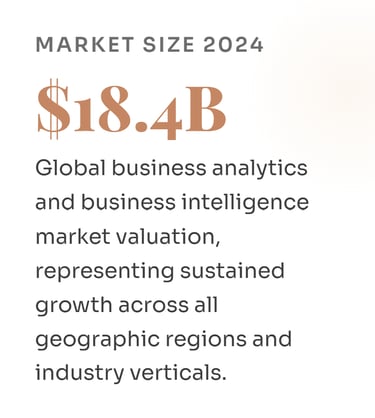
The global business analytics market is experiencing explosive growth, driven by increasing organizational dependency on data-driven insights. Companies across all sectors recognize that advanced analytics capabilities are no longer luxury investments but essential strategic requirements for competitive success. The convergence of digital transformation, artificial intelligence advancement, and exponential data growth creates unprecedented demand for sophisticated analytics platforms.
North America leads in adoption and spending, but Asia-Pacific is growing fastest as digitalization accelerates. Key growth sectors include financial services, healthcare, retail, manufacturing, and technology.
Primary Growth Drivers
Six fundamental forces are accelerating analytics adoption across organizations of all sizes. Exponential data growth from IoT devices, social platforms, mobile applications, and cloud services demands sophisticated processing tools capable of handling massive datasets at scale. Organizations generate more data monthly than entire companies collected annually a decade ago.
Digital transformation embeds analytics into core business operations, extending beyond technology adoption to encompass cultural change and decision-making framework evolution. The shift from historical reporting to real-time insights creates competitive advantages through faster response times and more informed decision-making. Real-time dashboards and automated alerting are rapidly moving from advanced features to baseline requirements.
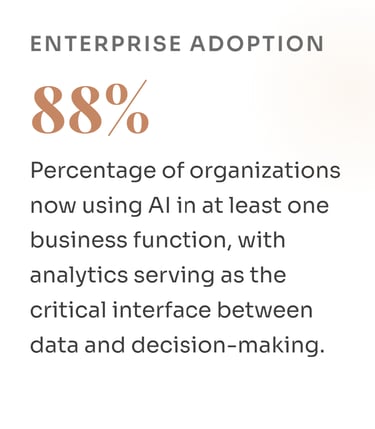
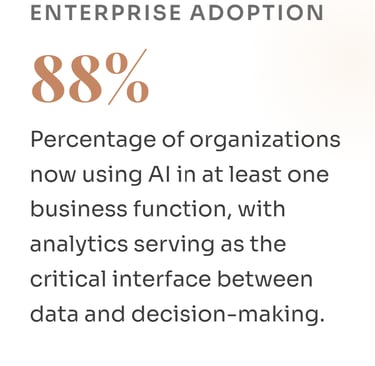
Cloud computing maturation has removed historical barriers, offering scalability without capital expenditure through integrated ecosystems from AWS, Azure, and Google Cloud. Self-service platforms like Tableau, Power BI, and Looker Studio empower non-technical users to build dashboards independently, eliminating traditional IT bottlenecks. Meanwhile, AI and machine learning integration enables automated insight generation, predictive capabilities, and conversational analytics through natural language processing, making advanced analysis accessible to broader organizational populations.
Leading Market Players
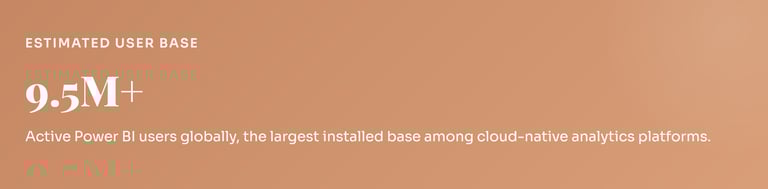
The analytics market features several dominant players alongside emerging specialists. Microsoft leads through Power BI's combination of accessibility and enterprise capability, integrated with Azure and Microsoft 365. Copilot integration enables conversational analytics for non-technical users.
Salesforce's $15.7 billion acquisition of Tableau positioned it as an enterprise analytics leader, with Tableau GPT now enabling AI-powered analysis. Google consolidated its portfolio by rebranding Data Studio to Looker Studio and integrating it with BigQuery for petabyte-scale analysis. Beyond the big three, specialists like Alteryx, Qlik, SAS, and Sisense thrive in specific segments, demonstrating that market segmentation supports multiple successful vendors.
Key Challenges
Poor data quality remains the most common obstacle, with organizations struggling against inconsistent definitions, incomplete records, and weak governance frameworks. Many lack clear data ownership structures necessary to maintain quality at scale. Regulatory complexity from GDPR, CCPA, and HIPAA adds significant compliance overhead, requiring robust data protection, access controls, and audit trails. Meanwhile, integrating modern platforms with legacy systems and fragmented data sources remains technically demanding, as older systems often lack robust APIs or modern integration capabilities.
Perhaps most critically, translating capability into business impact remains elusive. According to Boston Consulting Group, only 5% of companies fully realize expected value from AI and analytics investments—highlighting that success requires organizational culture change, not just technical deployment.
Emerging Trends and Future Outlook
Analytics platforms are evolving from passive dashboards toward active decision intelligence systems that recommend specific actions based on organizational objectives and external factors. Machine learning increasingly identifies anomalies and opportunities automatically without explicit user queries, enabling organizations to maintain visibility across massive datasets without overwhelming analysts. Composable architectures let organizations assemble best-of-breed components instead of relying on monolithic platforms, enabling adaptation as requirements evolve while avoiding vendor lock-in.
Edge analytics is bringing processing to devices for real-time decision-making in areas like IoT monitoring and autonomous vehicles, reducing latency while addressing privacy concerns. Responsible AI frameworks addressing bias detection, model explainability, and governance are becoming essential, particularly in regulated industries and for privacy-conscious customers. Industry-specific solutions tailored for financial services, healthcare, and manufacturing are gaining market share, while collaborative analytics features are seeing increased demand as remote work drives the need for shared analytical environments with version control and shared annotations.
Key Takeaways
Advanced analytics capabilities now represent baseline requirements for effective operations, not competitive advantages. Organizations should develop comprehensive analytics strategies aligned with business objectives, invest in data governance and quality, build organizational capability through training, and maintain relentless focus on business value realization rather than technical capability alone.
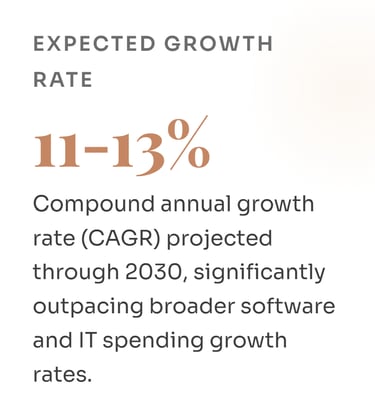
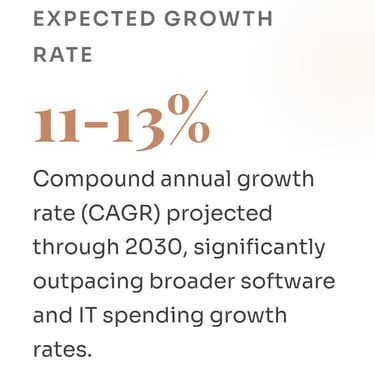
For investors, the sector offers sustained double-digit growth potential fueled by structural enterprise demand, increasing AI adoption, and continuous digital transformation investment. The analytics market continues experiencing consolidation, with major acquisitions like Salesforce's Tableau deal and Google's Looker purchase demonstrating strategic importance, while strong venture funding continues supporting specialized vendors in emerging segments.
The market is positioned for continued expansion through the current decade. Vendors offering integrated, user-friendly platforms with robust security, governance, and AI capabilities are best positioned to capitalize. The convergence of digital transformation, data growth, and organizational need creates strong tailwinds that show no signs of slowing.
Sources and References
Gartner Inc. (2024). Magic Quadrant for Business Intelligence and Analytics Platforms.
McKinsey & Company. (2024). AI and analytics adoption in 2024.
Forrester Research. (2023–2024). The State of Enterprise Analytics.
IDC. (2024). Global Business Analytics and Business Intelligence Market.
Boston Consulting Group. (2024). Scaling AI: The value realization challenge.
We turn market complexity into executive decisions
Get in Touch
© 2026. All rights reserved.