From AI experimentation to enterprise redesign
AI-Powered Business Transformation & Workflow Automation for Scalable Growth and Digital Innovation.
LINO Consulting & Research GmbH
5/13/20263 min read


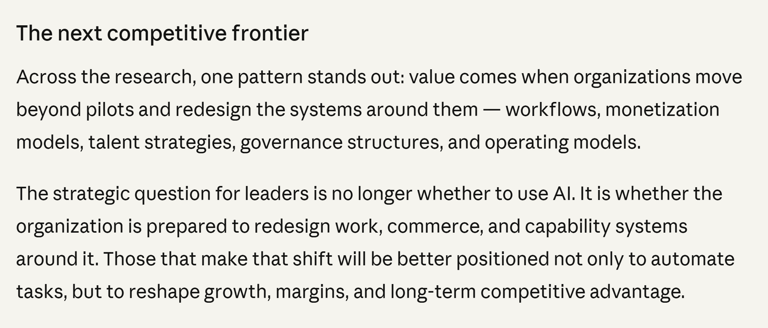
The next phase of AI is no longer about tool adoption alone. It's about redesigning workflows, revenue engines, and organizational structures so AI can create measurable business value.
Adoption is broad, but value remains uneven
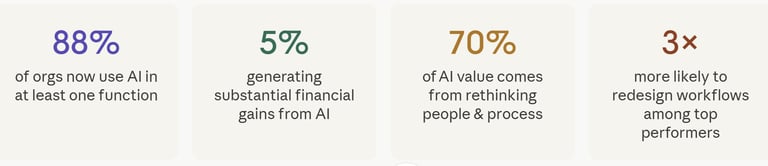
AI adoption has accelerated rapidly. One global survey found that 88% of respondents say their organizations now use AI in at least one business function, up from 78% a year earlier. Yet scale remains limited. Nearly two-thirds say their organizations have not begun scaling AI across the enterprise, and only 39% report any enterprise-level EBIT impact from AI. Most of those reporting EBIT impact say it represents less than 5% of EBIT.
That gap between experimentation and value creation is significant. Only about 5% of organizations are generating substantial financial gains from AI, and those companies outperform laggards on broader financial metrics and three-year shareholder returns. The implication is clear: deploying AI is no longer enough. Competitive advantage is shifting toward organizations that redesign how work gets done.
Workflow redesign is becoming the real source of advantage
The strongest signal emerging from recent research is that leading organizations do not simply layer AI onto existing processes. They redesign workflows around it. High-performing organizations are nearly three times as likely as peers to have redesigned individual workflows, and this redesign is one of the most important drivers of business impact. These organizations are also more likely to scale AI agents and pursue growth and innovation objectives rather than focusing only on efficiency.
Research reinforces this: only 10% of AI value comes from algorithms and 20% from the enabling technology stack. The remaining 70% comes from rethinking the people dimension of transformation — aligning AI to enterprise priorities, governing it through measurable KPIs, and building an operating model that supports human-AI collaboration.
New channels are creating new monetization loops
Southeast Asia's digital economy is projected to surpass $300 billion in GMV in 2025, with revenues expected to reach $135 billion. Over the past decade, the region has delivered 7.4× GMV growth and 11.2× revenue growth, supported by more than 200 million new internet users.
E-commerce GMV is expected to reach $185 billion in 2025, with video commerce accounting for roughly 25% of total GMV. Delivery platforms are adding new revenue streams such as advertising, dine-in vouchers, loyalty subscriptions, and cloud kitchens. Mobility platforms are similarly expanding through tiered services, subscription bundles, and in-app advertising.
These are reinforcing monetization loops built into the operating model. The commercial winners are redesigning customer journeys, platform economics, and channel structures so AI, data, and ecosystem participation continuously strengthen one another.
The workforce is now central to transformation risk and return
Workforce design is emerging as one of the most decisive factors in AI transformation. Organizations that are further ahead plan to upskill more than 50% of employees on AI, compared with 20% among laggards. They are also four times more likely to have structured learning programs and five times more likely to conduct strategic workforce planning.
At the same time, 32% of respondents expect enterprise-wide workforce reductions of 3% or more in the coming year, while many organizations continue hiring for AI-related roles. This creates a dual challenge: underinvesting in workforce redesign limits value creation, but focusing on technology without role clarity increases friction, slows adoption, and weakens execution.

We turn market complexity into executive decisions
Get in Touch
© 2026. All rights reserved.